The Book of Mirrors manuscript
The Book of MirrorsThe Book of Mirrors manuscript is Richard Flynn’s attempt to turn the events surrounding Laura Baines and Professor Joseph Wieder into a delayed account of a truth he says he discovered years later. A completed work rather than merely a fragmentary proposal, it survives in the investigation chiefly through an excerpt and notes. Its absence is consequential: the text begins to expose Flynn’s version of the past, but its missing remainder becomes a mystery in its own right and prompts others to reconstruct the story it was meant to tell.
Origin and Intended Account
Flynn describes the manuscript as the result of memories of 1987 returning with unusual force. The events had once attracted newspapers, police detectives, and reporters, but, in his account, nobody had learned the whole truth. He says he stumbled upon that truth three months before writing his query and felt compelled to share it despite the anger and frustration the discovery revived. Completing the manuscript left him physically and mentally exhausted.
The events at its center involve Flynn, Laura Baines, and Professor Joseph Wieder. Flynn presents the book as more than a record of a notorious murder: he says that the events changed his life, and his account is shaped by the long interval between what happened and his decision to write about it. He had left Princeton after the police and press attention, pursuing an MA at Cornell in Ithaca. He also says that he had never truly forgotten Laura, a personal history that helps explain why the old events remained vivid to him without establishing that the manuscript is simply a memoir of their relationship.
Flynn’s query calls the manuscript complete and ready for submission and gives its full length as 78,000 words. He offers a sample to an agent, presenting the book as a finished account rather than an outline. The distinction matters: the sample ends before the murder, and its stopping point makes the absent material seem essential to understanding both the crime and Flynn’s purpose in writing.
The Surviving Excerpt
The fragment follows Flynn’s developing suspicion that Laura has deceived him. After reconsidering what she told him about the library, he wonders whether the explanation was a pretext and whether he had been treated like a subject in an experiment. His interpretation shifts sharply: what had seemed like a series of separate explanations now appears to him to be a pattern of lies. He leaves, calls for a cab, and sets out through increasingly heavy snow toward Wieder’s house.
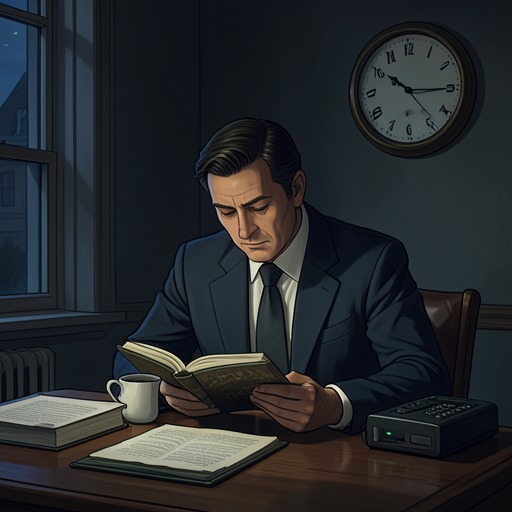
That journey is where the surviving partial manuscript ends. The reader of the excerpt has spent more than two uninterrupted hours with it when the clock reads 1:46 a.m.; the narrative stops not at a resolution but at the threshold of a new scene. The fragment’s abrupt boundary makes the visit to Wieder’s house a charged promise rather than a documented conclusion. Flynn’s sample thus offers a point of view and a mounting suspicion, but not the portion that could confirm what happened next.
Disappearance and Editorial Search
The missing text becomes a practical problem after Flynn’s death. When Peter Katz recounts the manuscript’s history, he says that Flynn died the previous month and that Flynn’s partner, Danna Olsen, had found no trace of the book. Olsen does not know where the remainder is. Although she offers to search the small Lenovo Flynn left behind, she says she would need to speak with him before handing over any manuscript she might find. Flynn’s death turns that unresolved permission into part of the search’s difficulty.
Katz sees commercial potential in the material but regards the surviving fragment as insufficient by itself. He proposes that the investigation either find the missing manuscript or reconstruct the events so the excerpt could be incorporated into a new book. He hires the former reporter who has been reading Flynn’s sample, supplies a copy of its first portion and his own notes, and obtains a signed contract with a nondisclosure clause. The assignment therefore grows out of the manuscript’s incompleteness: its absence determines the investigator’s task and the proposed shape of the book that might replace it.
The search also produces a separate archival trail that must not be confused with Flynn’s work. Investigation of Wieder’s publishing history reveals that Wieder had submitted his own book proposal, with a first chapter, to Allman & Limpkin in July 1987; a contract followed in August, and the publisher expected revisions in November. Wieder requested extra time to polish the text over the holidays, but the full manuscript never reached the publisher. This proposal concerns Wieder’s book, not Flynn’s The Book of Mirrors manuscript, yet the parallel loss deepens the investigation’s central problem: crucial accounts of the past are known through partial documents, while the complete texts remain unavailable.
Reconstruction and Narrative Function
As the investigator follows the excerpt’s clues, the book’s presumed subject shifts. The initial search is for Flynn’s missing pages, but the work increasingly directs attention toward Wieder and the circumstances of his death. Flynn’s sample supplies names, a setting, and a time frame; Katz argues that these may be enough to begin rebuilding the final days even if the manuscript cannot be found. The proposed reconstruction is not presented as equivalent to recovering Flynn’s own ending. It is an attempt to make sense of the story from scattered evidence.
That evidence includes the account of Frank Spoel, who confesses to killing Wieder and says he intended to beat him, not kill him. Spoel recalls watching Wieder’s house and arriving on December 21 to find the professor drinking with a young man. He identifies the man only in broad terms; the investigator suggests he may have been Richard Flynn. Spoel also insists that, hours later, someone unlocked the door and entered the house, while the investigator points out that Wieder did not die immediately and that the visitor apparently failed to summon an ambulance. These details complicate rather than settle the account suggested by the excerpt: the manuscript’s route to Wieder’s house intersects with testimony about who was there and what happened afterward, but the testimony leaves consequential gaps.
The manuscript consequently functions both as a narrative and as an absent object. Its fragment invites confidence in Flynn’s perspective, while the inability to consult the complete work prevents that perspective from serving as a final explanation. The investigator must move between a personal account, publisher records, and later testimony, none of which supplies the whole story alone. The missing ending keeps Flynn’s promised disclosure unresolved and makes the act of reconstructing the past part of the book’s subject, rather than a simple substitute for reading the manuscript.